Bus stop accessibility: Designing for inclusive public transport infrastructure
Creating accessible bus stops is not just a tick box for compliance – it’s a basic part of delivering safe, inclusive and future-ready public transport infrastructure.
The Bus Services Act 2025 was a key legislative step to improve the accessibility of bus services in England, setting new standards for the provision of accessible bus stops and related infrastructure.
For local authorities, transport executives, contractors and planners, bus stop accessibility directly impacts passenger confidence, network efficiency and community inclusion. From wheelchair users and people with visual impairments to older passengers, parents with pushchairs and those with hidden disabilities, an accessible transport system benefits everyone.
At GW Shelter Solutions, we work closely with councils and contractors across the UK to deliver compliant, durable and inclusive bus stop infrastructure that aligns with current legislation and best practice guidance. Local authorities are responsible for managing their streets and roads for all users, so the provision of accessible infrastructure is essential, and we reference statutory guidance as a key resource to ensure our solutions meet the highest standards for safety and inclusion.
Why bus stop accessibility matters
Accessible bus stop design:
- Enables independent travel for disabled passengers
- Reduces dwell times and improves operational efficiency
- Supports Equality Act obligations
- Enhances passenger safety and comfort
- Improves public perception of local transport networks
- Supports the needs of all bus users, including disabled and older individuals
Under the Equality Act 2010, public authorities have a duty to make reasonable adjustments and ensure services are accessible. In practice, that means bus stop infrastructure must not create barriers to access.
Accessible bus routes are essential for ensuring all users, including those with disabilities, can travel independently and efficiently across the network.
Poorly designed stops – narrow boarding areas, obstructed footways, inadequate kerb heights – can prevent safe boarding, even where buses themselves are fully accessible.
Inclusive infrastructure is therefore not an add-on – it’s core to seamless transport infrastructure. Accessible design benefits everyone, not just those less abled.
Key features of accessible bus stop design guidance
When reviewing bus stop accessibility guidance, councils should focus on three core areas:
Step-free boarding and kerb alignment
Correct kerb height and clear boarding areas are critical for wheelchair access and level boarding.
Best practice typically includes:
- Raised kerbs (commonly 125-160mm to suit low-floor buses)
- Clear, obstruction-free boarding zones
- Sufficient footway width to allow wheelchair manoeuvring
- Accurate bus alignment with the kerb
A bus boarding island can provide a dedicated, accessible area for boarding and alighting, especially where cycle tracks are present.
Without proper kerb design, even low-floor buses cannot deploy ramps safely. It is important to maintain a safe distance between boarding areas, cycle tracks, and pedestrian zones to ensure safety for all users.
Adequate footway width and clear zones
Accessible bus stop design guidance emphasises maintaining minimum clear widths to allow:
- Wheelchair turning circles
- Passing space for mobility aids
- Clear sightlines for visually impaired users
It is important to regularly review existing sites to ensure they meet current accessibility standards, especially where cycle tracks and bus stops meet. Assessing user profiles and available space can help determine if adaptations, such as bus boarding islands or new markings, are needed for safety and compliance.
Street furniture, signage and shelter supports must not reduce effective footway width below recommended standards. Thoughtful layout planning is essential, particularly in constrained urban environments.
Pavements leading to bus stops should be at least 2 meters wide and accessible.
Shelter accessibility and inclusive layout
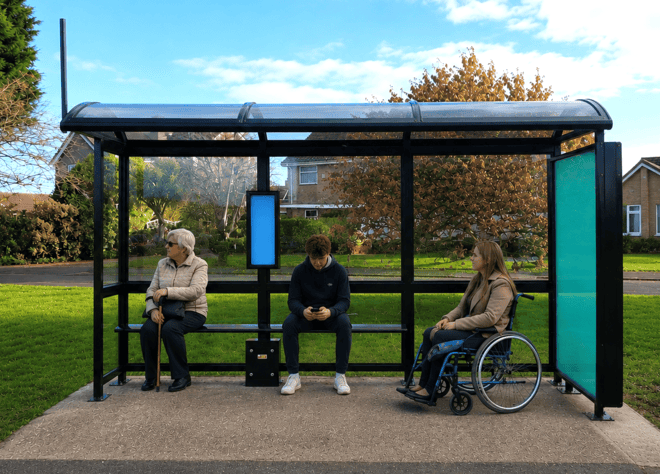
An accessible bus stop shelter should:
- Provide step-free access
- Include a wheelchair space within the shelter footprint
- Offer seating with armrests and varied seat heights
- Maintain sufficient clear headroom
- Avoid visual clutter or trip hazards
Key enhancements for bus stops include the provision of seating, sufficient space for wheelchair manoeuvring, proper lighting, and real-time information systems. These features can be installed to improve accessibility and user experience.
Seating design is particularly important for older passengers or those with reduced mobility. Armrests assist standing and sitting transitions, improving independence. The guidance also covers the provision of accessible infrastructure and details the types of features that can be installed at bus stops, such as shelters, seating, and real-time information displays.
Tactile paving and visual contrast
Accessible bus stop design guidance recommends the appropriate use of:
- Tactile paving to indicate boarding points
- High-contrast surfaces to support visually impaired users
- Clear, legible timetable information
- Non-glare glazing and panels
Visual contrast between the shelter structure, seating, kerb edges and surrounding pavement can significantly improve usability for those with visual impairments.
Lighting, safety and perception
Accessibility extends beyond physical dimensions.
Well-designed lighting:
- Improves personal safety
- Supports passengers with low vision
- Enhances CCTV coverage
- Increases evening usability
Shelters should be designed to eliminate concealed areas and promote passive surveillance, contributing to safer public spaces.
Surface quality
Surface condition is often overlooked in bus stop accessibility planning.
Councils should ensure:
- Even and non-slip surfacing
- No sudden level changes
- Durable materials suited to high footfall
Additionally, areas such as worn markings, damaged tactiles, or faded signs require attention to maintain safety and compliance.
What works in practice
From our experience delivering bus shelters and infrastructure across the UK, the most successful accessible schemes share common characteristics:
- Early collaboration between planners, highways teams and contractors
- Accurate site surveys before specification. Reviewing existing sites is crucial for identifying opportunities for accessibility improvements, such as adapting current infrastructure or converting layouts to safer configurations.
Retrofitting accessibility is always more complex and costly than getting it right at the design stage.
How GW Shelter Solutions supports accessible bus stop installation
At GW Shelter Solutions, we support councils and contractors with:
- Technical specification guidance
- Bespoke and standard accessible shelter designs
- Structural compliance and durability assurance
- Installation support
- Integration with the existing highway infrastructure
Our decades of experience mean we understand the operational realities faced by transport authorities and work to ensure infrastructure is not only compliant but practical and cost-effective.
Our approach combines regulatory awareness with real-world installation experience, ensuring each project supports inclusive public transport access for the long term.